

LCEI case studies
Please note:
The LCEI Business Grant Fund is now closed. For research or collaboration opportunities, please contact us at ecoinnovatory@ljmu.ac.uk.
Beverston Engineering
Investment: £95,887 business spend supported by £25,000 LCEI business grant
The project: Solar PV System
Carbon savings: 45 tonnes CO2e per year | 1,008.5t CO2e over the 15-20-year lifespan
Projected financial savings: £26,599 per year savings on energy bills
 Beverston Engineering is a leading provider of precision engineering and advanced CNC machining services, specialising in the production of safety-critical metal components for sectors including aerospace, pharmaceutical, oil and gas, and nuclear.
Founded in 1974, over the decades Beverston Engineering has made huge leaps forward in adopting operational efficiencies and cutting-edge technologies. Sustainability has also become a major focus for the company, with a business plan focused on sustainable growth and the aim to achieve net zero by 2030. Critical to this is investment in a large-scale solar PV system at their Knowsley headquarters.
Beverston partnered with LCEI to explore the benefits of installing a 202.5kwp solar PV system, which they anticipated would significantly reduce their reliance on grid electricity and fossil fuels, leading to substantial cost savings and carbon reduction.
Our LCEI researcher calculated that the system would generate approximately 156,106.2kwh annually, representing around £26,599 savings a year on energy bills and a carbon reduction of approximately 34.61tonnes CO2e a year. Over the lifespan of the PV panels, there would be a carbon saving of 798.116t.
The LCEI team supported Beverston through the grant application and procurement process and their solar PV system is now up and running.
Beverston will be able to harness the data from their new PV system to develop an energy management system and optimised production schedules – giving them a significant competitive edge.
The installation showcases Beverston’s commitment to sustainable manufacturing and the transition to a low-carbon economy.
Beverston Contracts Manager Gemma Murphy said: “The Low Carbon Eco Innovatory project has had a genuinely positive impact on our business. The guidance and expertise we received from the LCEI team gave us the confidence to invest in solar. Despite our installation taking place in winter, it has already significantly reduced our energy costs and helped us progress toward our sustainability goals.”
Royal Liverpool Philharmonic Society
Investment: £10,535 business spend supported by £5,650 LCEI business grant
The project: LED stage lighting
Carbon savings: 4.57 tonnes CO2e per year | 41.1t CO2e over the nine-year lifespan of the lights
Projected financial savings: £5,573 per year savings on energy bills
 The Philharmonic Hall on Hope Street is an integral part of Liverpool’s cultural offering.
It is home to the Royal Liverpool Philharmonic Orchestra and an extensive engagement programme with young people and other communities. Over 300,000 people attend concerts at the iconic art deco venue each year.
As part of its sustainability strategy, the organisation aimed to reduce its carbon emissions and overall energy usage. A key area identified for improvement was the stage lighting in Philharmonic Hall.
They partnered with LCEI to explore the financial and environmental benefits of replacing outdated filament bulbs with energy efficient LEDs.
LEDs last longer and use less energy – and our LCEI researcher calculated that the Philharmonic stood to save £5,573.85 a year on energy bills and bulb replacement and reduce carbon emissions by 4.57 tonnes CO2e per year.
This carbon impact is the equivalent of driving an average-sized car 17,034 miles in the UK. LCEI supported Liverpool Philharmonic to apply for the LCEI Business Grant, and they received £5,650 towards the installation costs.
Emma Carey, Head of Production at Liverpool Philharmonic said: “The new LEDs offer a significant reduction in energy consumption and reduced energy costs for our charity. As we don’t need to regularly replace lamps, this has also led to a reduction in waste and reduced workload for the production team. The new LEDs have also improved our safety standards as the previous lamps had a high heat output that transferred to the fixture, with a risk of causing superficial burns.”
Trojan Lighting
Investment: £2,599 business spend supported by £750 LCEI business grant
The project: 3D Printer
Carbon savings: 0.23 tonnes CO2e per year | 3.44t CO2e over the 15-year lifespan
Projected financial savings: £130 per year savings on energy bills
 Trojan Lighting is an established lighting manufacture and design company, providing intelligent LED lighting solutions for the healthcare, education, commercial, retail and public sectors.
The company specialises in sustainable lighting solutions, focusing on the re-use and retrofit of existing equipment wherever possible and designing products to the highest standards of energy efficiency and environmental responsibility.
Trojan has integrated eco-friendly practices into every aspect of the business – switching to an electric vehicle fleet, using paper instead of plastic packaging, and generating energy on-site with solar panels.
The company was searching for ways to further reduce their carbon emissions and had identified a 3D printer that they wanted to integrate into their processes. The printer would allow them to manufacture components on site and rapidly prototype new ideas, opening up new areas for growth.
LCEI partnered with Trojan to explore the potential environmental impact of the 3D printer. Our researcher showed that by reducing the need for packaging and transporting new components to site, and using recycled plastic instead of steel, the printer would reduce carbon emissions from component manufacture by 0.23 tonnes CO2e a year.
The LCEI team supported Trojan to apply for the LCEI business grant and they were awarded £750 towards the cost of the printer.
Stuart Aiken, Trojan Marketing & Communication Director, said: "Working with LCEI has been great. They are knowledgeable and pragmatic and have supported our business objectives with advice and funding that has made a real difference. With the introduction of additive manufacturing to our production process, we are able to carry out rapid prototyping and reduce the cost of transporting raw materials."
Camper Camper
Investment: £22,788 business spend supported by £9,495 LCEI business grant
The project: Investment in a new CNC router machine
Carbon savings: 739.1kg CO2e per year | 7.39t CO2e over the lifespan of the machine
Projected financial savings: £259 per year saving on energy bills
 The market for camper van conversions has exploded in recent years. One Merseyside company that’s driving this trend regionally is Camper Camper, based in Bootle.
Founded in 2018 by Tom Davies, inspired by his own travels and experiences of van life, the company now provides custom van conversions as well as van hire and accessories for van self-builders.
The business wanted to increase efficiency while reducing carbon emissions, to support their plan for sustainable, clean growth.
They were using traditional hand power tools to build the wooden carcasses for internal fit-outs, but they wanted to invest in a new CNC router, which would allow greater precision, streamline production, and reduce waste materials.
They estimated that, by more efficiently identifying how components can be ‘nested’ before they are cut, the CNC machine would reduce waste material by 20 to 25%. LCEI’s Researcher Dr Cameron Kelly calculated the carbon saved via the introduction of the CNC machine, focusing on reduced energy use and waste.
His report showed that the CNC machine will save 739.1kg CO2e in its first year of use, and 7.39 tonnes CO2e over its lifetime. Camper Camper also stands to save approximately £259 a year on their energy bills.
LCEI supported Camper Camper to apply for the LCEI Business Grant, and they were awarded £9,495 towards their purchase costs. They were supported through all grant stages, from procurement to defrayal and drawdown of grant funds.
This new manufacturing process will increase consistency across van builds and allow Camper Camper to offer more bespoke designs.
Additionally, automating parts of the van conversions will free-up skilled workers for more complex value-added tasks, such as installation, finishing, and customisation, improving build quality and turnaround times.
Tom Davies said: “We see this investment as a key step in growing Camper Camper, creating local employment, and futureproofing the business. The CNC router will allow us to increase production capacity, improve efficiency, and reduce material waste, supporting both commercial growth and our sustainability goals.
“This investment will enable us to create new skilled roles, reduce our carbon footprint, and build a more efficient, scalable and resilient business for the future.”
Crosby Coffee
Investment: £160,000 business spend supported by £20,000 LCEI business grant
Project: Investment into a new, larger capacity and more energy efficient coffee roaster
Carbon savings: 25.96t CO2e per year | 389.4t CO2e over the 15-year lifespan of the equipment
Projected financial savings: £8,612.35 per year saving on energy bills
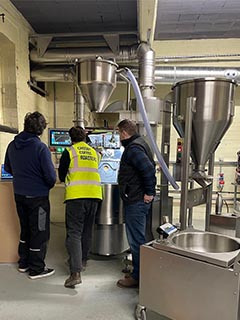 Crosby Coffee has built a reputation across the Liverpool region as not only purveyors of excellent coffee, but as a business with an ethical approach and sustainability at its heart.
Having worked with LCEI previously to understand its carbon emissions, Crosby Coffee had already developed a Sustainable Growth Plan and identified the need to update a range of equipment to meet customer demand, support business growth, and reduce energy usage.
They identified a bespoke coffee roaster that would be 100% faster and 20% larger in capacity, while also 70% more energy efficient than their current gas-fired roaster.
LCEI researcher Dr Cameron Kelly calculated that the new roaster vastly reduced gas consumption, from 164,999.0kWh per year to 36,424.5kWh per year. This equates to a carbon saving of 25.96 tonnes CO2e per year, and 389.4 tonnes CO2e over the 15-year lifespan of the roaster. Crosby Coffee would save approximately £8,612.35 per year on energy bills.
The LCEI team supported Crosby Coffee through the grant application process and were on hand for every stage through procurement, defrayal and drawdown of the grant funds. The team will continue to work with Crosby Coffee to monitor ongoing carbon savings.
Mark Slinger, Crosby Coffee co-founder and director said “Having a greater capacity for larger amounts of coffee to be roasted will create huge opportunities for growth whilst reducing energy consumption and carbon emissions. We will continue to grow organically, opening premises and building our wholesale and delivery services and other complimentary products and services to our customers.”
Kenay Ltd
Investment: £40,000 business spend supported by £20,000 LCEI business grant
Project: Investment into a new, more efficient napkin print machine
Carbon savings: 1.73t CO2e per year | 34.6t CO2e over the 20-year lifespan of the equipment
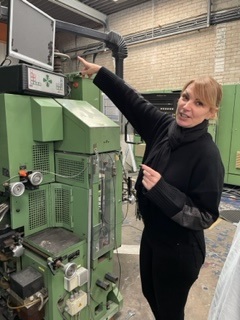
Runcorn-based Kenay Ltd specialises in tabletop disposables including printed tissue napkins and paper table covers.
Founded in 1999, in recent years Kenay had been missing out on contracts due to changing consumer demands and increasing international competition. As a small manufacturer aiming for growth, they knew they had to upgrade their machinery to remain competitive, while also reducing their carbon emissions and waste.
They identified a modern napkin print machine that could replace two of their oldest and slowest machines. The new machine would be faster, more efficient and produce less scrap, as well as enabling them to print in up to six colours and two sizes. Improved technology would allow for fast fault reporting and significant waste reduction.
They partnered with LCEI, and our researcher carried out a comprehensive waste carbon saving report, calculating that the new machine would be 70 per cent more efficient, reducing scrap paper by 1,122kg per year and saving 1.73t CO2e per year.
With LCEI’s support, Kenay has switched up its manufacturing processes, allowing them to offer a better service, more competitive prices and an improved product range, while opening up new opportunities.
Oakhurst Ltd
Investment: £65,773 business spend, supported by £20,000 LCEI business grant
Project: New air filtration and particle extraction system
Carbon savings: 1.9 - 3 tonnes CO2e during first year of operation
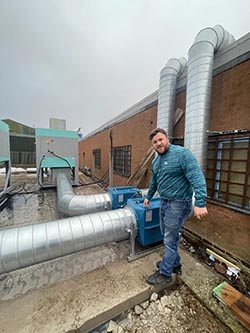 Southport-based shop-fitting and construction company Oakhurst Ltd had plans to scale up their business via new partnerships and diversifying their services.
They were preparing to launch a new product that would take Oakhurst into new markets and identified a need to upgrade their workshop equipment to support this projected growth. They also wanted to reduce their carbon emissions and move towards more sustainable operations.
They partnered with LCEI to explore the carbon savings from installing a new air filtration system.
LCEI researcher Dr Cameron Kelly compared their current equipment with the proposed new filtration system, with both running at increased production levels, and calculated that the new system would save between 1.9 and 3 tonnes CO2e during the first year of use.
The new system would also create a healthier working environment for Oakhurst’s workshop employees.
The LCEI team supported Oakhurst through the grant application process. After approval by the LCEI grant panel, the team were on hand for every stage through procurement, defrayal and claiming of grant funds.
Oakhurst Director Richard Hurst said: “It’s important that we achieve clean and sustainable growth and working towards Net Zero will be a factor in our supply chain.
“The new system is as low carbon as possible and provides more capacity and flexibility. We now have a quantifiably better extraction system fit for purpose.”
JJ Smith Woodworking Machinery Ltd
Investment: £4,434 supported by 50% LCEI Grant of £2,217
Project: Cardboard shredding machine to reduce the use of plastic packaging
Carbon savings: 1t CO2e per year
Projected financial saving: Saving on purchase of plastic bubble wrap
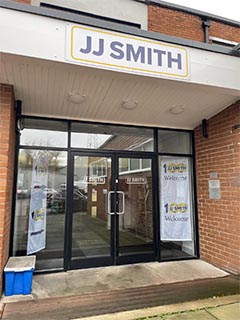 A family business founded in 1923, JJ Smith Woodworking Machinery Ltd is a major supplier of new and used woodworking machinery exporting and installing across the globe.
Understanding the need to reduce their carbon emissions, the Knowsley-based award-winning business has developed a clean growth strategy, aiming to reduce plastic waste, increase recycling and save energy.
They identified that if they re-purposed the large amount of waste cardboard in their operations, it could be used to replace plastic packaging. The business was using 1x100m roll of bubble wrap per fortnight for their parcels, at a cost of around £20 a roll, while simultaneously being inundated with additional cardboard that needed to be recycled.
They wanted to purchase their own cardboard shredder, to create packaging for smaller parcels from the waste cardboard, reducing the use of single-use plastic wrapping.
LCEI’s expert researcher compared the carbon lifecycle of the bubble wrap to the operation of the cardboard shredder, calculating that JJ Smith could save 1 tonne CO2e per year.
The LCEI team supported JJ Smith to apply for the LCEI business grant, to fund up to 50% of the cost of the cardboard shredder.
JJ Smith Commercial Manager Linzi Edwards said: “This project reflects our dedication to responsible growth and delivering value to our customers, demonstrating how small changes can make a big impact.”
Innovation Chemicals Ltd
Investment: £8,268 supported by LCEI Grant of £3,445
Project: 52 x 300 litre bulk liquid containers
Carbon savings: 12.42t CO2e per year | 124.15t CO2e over the 10-year lifespan of the equipment
Projected financial saving: Reduced utility bills and cost saving on raw ingredients
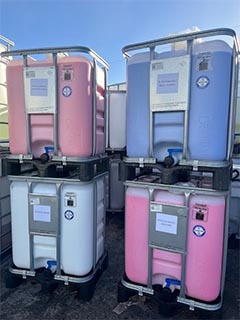 Halton-based Innovation Chemicals manufactures a variety of laundry and cleaning products, working with large commercial customers.
Innovation Chemicals wanted to reduce waste chemical mix and speed up the turnaround of new products – supporting innovation and allowing them to be more responsive to market changes and demands.
In developing new products, Innovation Chemicals uses 1,000 litre Intermediate Bulk Containers (IBCs). They needed to invest in 300 litre containers to make the business more agile, but they also wanted to understand the environmental benefits of mixing in smaller batches.
LCEI’s researcher compared the process of mixing 1,000 litres and 300 litres, looking at transport of the raw chemicals, energy used to produce different mix quantities, and levels of waste chemicals, calculating that by switching to 300 litre containers, Innovation Chemicals could save 12.42 tonnes CO2e per year.
The LCEI team supported Innovation Chemicals to apply for the LCEI Business Grant, to fund up to 50% of the cost of 52 x 300 litre containers.
Director Carol Longshaw said: “We are incredibly grateful for the funding provided by LCEI. This support has not only made expanding our product range more affordable but also enabled us to scale our operations while prioritising sustainability.”
A.Algeo Ltd
Investment: £30,000 supported by LCEI Grant of £13,000
Project: Replacing outdated AC units with a new, more efficient heating/cooling system
Carbon savings: 1.4t CO2e per year | 21.03t CO2e over the 15-year lifespan of the equipment
Projected financial saving: £1,866 on utility bills per year
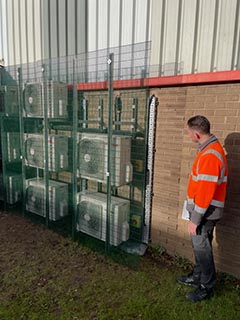 Liverpool based Algeos Ltd manufactures and distributes medical devices and consumables for the prosthetic, orthotic, podiatry, physiotherapy, care and rehabilitation markets globally.
As part of its long-term growth strategy, the business aims to achieve Net Zero by 2030 and has implemented a series of initiatives to support this.
During environmental auditing, they determined that their dated AC units needed replacing, which would bring about positive impacts for their carbon footprint and energy bills.
Our LCEI researcher produced a report which showed that the new system would save 1.4 tonnes CO2e per year compared to the old AC units, which over their 15-year lifespan, would equate to a carbon saving of 21.03 tonnes. The business also stands to save £1,866 on its annual energy bills.
The LCEI team supported Algeos Ltd through the Business Grant process, and they were awarded funds towards their investment.
Operations Director Neil Smith said: “We found LCEI’s team helpful; providing professional and consultative advice throughout the process.
“The new AC units are in place with the support of the LCEI grant, which will help keep Algeos on our journey towards Net Zero in 2030, having a positive impact on the environment and our community in the future.”
Locker Freight
Investment: £35,604 – 50% funded by LCEI
Project: Replacing diesel forklift truck with electric
Carbon savings: 13.7t CO2e per year | 164.4t CO2e over the 12-year lifespan of the equipment
Projected financial saving: £1,918 on fuel costs per year
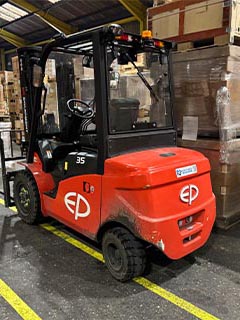 Locker Freight has been established for 52 years, specialising in national and international logistics, transport, storage and distribution.
The business, based in Knowsley, aims to replace its fleet of six diesel forklifts used in its warehouses with electric alternatives. As well as providing cleaner air quality in the work environment, this move supports their overall business objective of reducing their carbon footprint.
Locker Freight had already invested significantly in replacing three of its forklifts. They then partnered with LCEI to continue phasing out diesel with the purchase of a fourth electric forklift.
University of Liverpool carried out research that identified a 13.7 tonne CO2e annual saving by switching to electric, and a saving of approximately £1,918 on fuel costs per year – equating to a return on investment in nine years.
Chris Goodfellow, Managing Director of Locker Freight, said: “Working with the LCEI team was a seamless process, and they couldn’t have been more helpful from the start to the end of the process.
“I had already started investing heavily in replacing the diesel trucks with electric, so when we were offered funding and advice from LCEI, we jumped at the chance to work with them.
“The electric trucks have not only created a much cleaner working environment for our warehouse team but are also contributing to making the air cleaner in the industrial area where we are located.”
Acorn Electrical Supplies Ltd
Investment: £17,273 supported by 50% LCEI Grant
Project: Replacing a gas-powered forklift truck with electric
Carbon savings: 2.76t CO2e per year | 41.42t CO2e over the 15-year lifespan
Projected financial saving: £3,621.33 on fuel costs per year
 Acorn Electrical Supplies is a wholesale supplier of electrical goods and renewables including LED lighting, solar panels, battery storage and air source heat pumps.
In recent years Acorn has expanded its renewable offering to customers alongside focusing on its own sustainability as a business.
The company has switched to electric company cars and installed solar panels and LED lighting. The next step was to replace their gas-powered forklift truck with an electric version that could be charged via their solar panels, reducing running costs and improving the air quality for staff in their warehouse.
Acorn partnered with LCEI to explore the potential carbon and cost savings of switching to an electric forklift. Our researcher calculated that in the first year of use, the new forklift would save 2.76 tonnes CO2e. Over the expected 15-year lifespan of the forklift, Acorn would save approximately 41.42t CO2e.
The LCEI project team then worked with Acorn through the Business Grant process.
Bob Gordon, Director of Acorn Electrical Supplies, said: “The benefits of the electric forklift are now obvious – the quiet operation and clean environment, along with energy bill savings via charging from our solar panels.
“I would highly recommend dealing with LJMU as they were fantastic through the whole process, from the initial grant application to paying the final grant, and were there whenever I needed anything.”
W Whiteside Ltd
Investment: £19,726.8 + VAT supported by 50% LCEI Grant
Project: Installation of solar PV panels
Carbon savings: 2.41t CO2e per year | 55.586t CO2e over the 20-year lifespan of the equipment
Projected financial saving: £2,000 on utility bills per year, payback period of 5.3 years
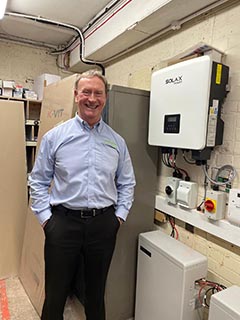 Established in 1977, W. Whiteside Ltd is a building and maintenance company working across the North West with some of the biggest names in hospitality.
The company has big plans to transition away from fossil fuels and source all its energy requirements from renewable sources.
As a first step, W. Whiteside wanted to install solar PV panels at its Knowsley premises. They partnered with LCEI to understand the potential carbon and financial savings.
LCEI’s researcher Dr Cameron Kelly calculated that the system would save 2.41t CO2e in its first year, and approximately £2,000 on their annual energy bill.
The LCEI team then supported W. Whiteside through the Business Grant application process, and they were approved for 50% funding towards their project.
In the next stages of its sustainability journey, W. Whiteside plans to install a heat pump to provide heating and hot water supplies, phase out diesel vehicles in favour of EVs, and install EV charging points in the company car park.
Director Barry Piggot said: “Thanks to the LCEI project we’ve successfully installed a 12.75kWp solar system through the project’s funding pot.
“This marks the beginning of our journey towards a more sustainable future, significantly reducing the carbon footprint of our office building and kickstarting our drive towards a greener tomorrow.”