

Suicide and Self-Harm Research Group
Lead: Professor Pooja Saini, Professor in Suicide and Self-Harm Prevention.
Co-leads: Dr Emma Ashworth, Reader in Child and Adolescent Mental health and Dr Molly McCarthy, NIHR Advanced Research Fellow.
What is the group about?
The Suicide and Self-Harm Research Group (SSHRG) builds on established areas of research excellence and aligns with the Department of Health Suicide Prevention Strategy (2023) and the National Health Service (NHS) Long Term Plan (2019, 2025).
The group undertakes interdisciplinary research focused on suicide prevention, self-harm, mental health service improvement, and postvention support, across community, clinical and educational settings.
The group’s work is organised across four interconnected strands: prevention, intervention, postvention and intelligence.
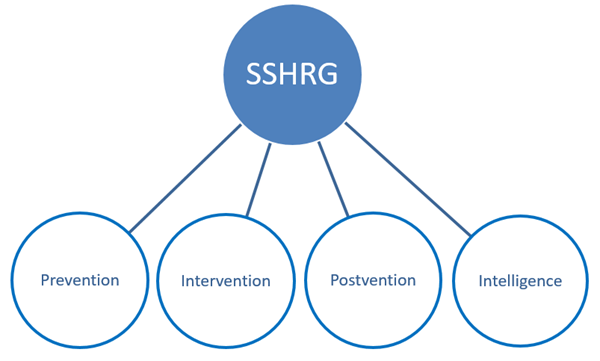
The prevention strand focuses on analysis of large datasets to improve the identification of risk factors and response pathways, as well as exploring decision-making processes related to suicide and self-harm. Current themes include women’s mental health, particularly premenstrual dysphoric disorder (PMDD) and menopause, school-based suicide prevention programmes, neurodiversity, and children and young people’s mental health.
The intervention strand focuses on responses to self-harm and suicidal behaviours, including the piloting, testing and implementation of innovative models in both community and hospital settings. Research within this strand includes emergency department practices, staff decision-making, and care pathways, alongside work relating to complex mental health presentations and risk consultation. The strand also includes research focused on men’s mental health, including work linked to James’s Place, and explores the role of emerging technologies such as Artificial Intelligence (AI) in mental health research and service delivery.
The postvention strand involves the evaluation and development of postvention services, alongside the piloting and implementation of new models of postvention care. It also includes research into community response plans following suicide-related events.
The intelligence strand focuses on the use of real-time surveillance data, as well as sharing of lessons learned and best practice regionally, nationally and within organisations.
Members
Academic staff
PhD students
Publications
Current and representative publications
Current and recent externally funded projects
- Women's Health: PMDD, Menopause
- Emergency Departments: Coding Practices, Staff Decision-Making, Care Pathways
- Complex Mental Health: Risk Consultation, Transformation Change, COMPAT
- Men’s Mental Health: James Place
- Neurodiversity
- Artificial Intelligence (AI)
- Children and Young People: Social Prescribing
- School-Based: MAPSS (Multi-Modal Approach to Preventing Suicide in Schools)

Public engagement
-
Schools suicide prevention model supported by Champs Collaborative wins innovation award
-
Prof Pooja Saini – Leading suicide prevention research at M-RIC
-
Dr Claire Hanlon - Member of the community innovation team for Sefton CAMHS and Comics youth, supporting their development of a co-produced service map of Sefton mental health support for young people.
Collaborations
Teaching and Learning conferences
Awards
Newsletters
-

Elizabeth Coen presenting her poster on protective and compensatory experiences for mental health of autistic children and young people.
-

Professor Pooja Saini at the Alfie's Squad Impact event.
-

Dr Molly McCarthy sharing findings as part of an international suicide prevention symposium.
-

Rashmi Liyanage presenting her work on understanding whether discrimination causes psychosis among ethnic minorities in the UK.
-

Laura Sambrook sharing findings on the recording of adverse childhood experiences in complex mental health patients.
-

Olivia Hendriks’s poster presenting her work into the predictors of suicide risk among peri-menopausal women.
-

Salma Shalaby presenting ’The Canaries’ Experience’ a VR experience that explores signs of distress.
-

Rio Foster sharing her PhD work into green social prescribing for improving children and young people's mental health.
-

Dr Claire Hanlon speaking as part of a panel about the importance of involving people with lived/living experience in research.
-

Dr Emma Ashworth sharing findings from MAPSS, a multi-modal approach to preventing suicide in schools, as part of an international symposium.